Showing posts with label Silver Sorceress. Show all posts

Wednesday, October 13, 2010

60 WEEKS WITH THE JUSTICE LEAGUE: Week 59

Justice League America #59
Feb. '92
Breakdowns Part 13
"Ex-Factor"
It's the final stretch for those tired, old racehorces:
Keith Giffen, plot & layouts
J.M. DeMatteis, writ & wit
Bart Sears, pencils
Elliott/Beatty, inks
Bob Lappan, letters
Gene D'Angelo, colors
Kevin Dooley, coming around the far turn
Andy Helfer, headed for the glue factory

Justice League Europe #35
Feb. '92
Breakdowns Part 14
"The Ceremony of Innocence"
A fond farewell from the battered and weary team of Gerard Jones, Darick Robertson, Romeo Tanghal, Willie Schubert, Gene D'Angelo, Kevin Dooley, and the most battered and most weary: Keith Giffen and Andy Helfer.


Marking the return of Kevin Maguire to cover duties (a great concept somewhat poorly executed), JLA finds the League taking its fight to KooeyKooeyKooey, where Dreamslayer (still in Max's body) has ensorcelled the natives into mindless obedience. Bart Sears--again aided and abetted by the one-two punch of Elliott and Beatty--delivers another solid issue, and one which ends on a serious cliffhanger: While Silver Sorceress bleeds to death on KooeyKooeyKooey, J'onn, Beetle, Metamporpho, BlueJay, Power Girl, Rocket Red and Fire are all brain-drained by Dreamslayer, who turns these Leaguers into "the new Extremists" and sends them back to the JLI's cave HQ to wipe out their fellow teammates.


In JLE, Darick Robertson (with inks this time by Romeo Tanghal) turns in his best issue to date, with stunning art and pitch-perfect layouts. After his somewhat brazen disregard for the page grid in recent issues, he here shows some real restraint that supports the issue's somber tone. However, he does have the chance to experiment with some more creative layouts when Silver Sorceress lures Dreamslayer into her own mind for a final showdown. As her body lay dying, Silver Sorceress finally manages to destroy Dreamslayer, and in so doing frees the captive minds and bodies of Maxwell Lord, much of the Justice League and all of the surviving inhabitants of KooeyKooeyKooey. Before dying, she also manages an explanation of sorts for the disparity between her name and the color of her costume: Turns out, Silver Sorceress was colorblind.


Worthy of note is this "Announcement!" from "Justice Log," detailing the fates of the League books and creative staff:

Since it's already a done deal (and so there's nothing you can do about it--NYEAH-HA-HA!) here is the new regular creative team on JLA/E (Kaiser roll, please): with #61 Dan Jurgens will be the main force behind JLA, both as writer and penciller. Over at JLE will be Gerard Jones, writer, and Ron Randall, penciller, with #37. Brian Augustyn, editor of THE FLASH, OUTLAWS, THE JAGUAR, THE FLY, and THE SHADOW STRIKES! will be the new editor. When asked what he thought about editing this...cacophony, Brian was heard to say "HA-HA-BWAH!" So expect something completely different. We think that all Justice League fans--yes, every single solitary one of you--will enjoy what's going to happen here.
Keith Giffen will still be plotting LEGION OF SUPER-HEROES, the LOBO PARAMILITARY CHRISTMAS SPECIAL (not for the weak-hearted), a new ECLIPSO series, and a fun, fun, fun title with a new hero called THE HECKLER.
What are those two crazy editorial kids going to do? Andy now has the esteemed position of Group Editor for Experimental Projects at Piranha Press, so expect interesting new things from that quarter. Kevin is now the editor of GREEN LANTERN (with more spin-offs to come), AQUAMAN, RAGMAN, THE HECKLER, and more.

Both issue's lettercols offer cover credits. From "Justice Log": "Kevin Maguire, pencils; Terry Austin, inks; Bob Le Rose, colors." From "Europinion": "Darick Robertson, pencils; Romeo Tanghal, inks; Bob Le Rose, colors."


See you in seven days for Week 60 of 60 Weeks with the Justice League, or: The End (as we know it).


The complete 60 Weeks with the Justice League on The Danger Digest:
#1, #2, #3, #4, #5, #6, #7, #8, #9, #10, #11, #12, #13, #14, #15, #16, #17, #18, #19, #20, #21, #22, #23, #24, #25/1, #26/2, #27/3, #28/4, #29/5, #30/6, #31/7, #32/8, #33/9, #34/10, #35/11, #36/12, #37/13, #38/14, #39/15, #40/16, #41/17, #42/18, #43/19, #44/20, #45/21, #46/22, #47/23, #48/24, #49/25, #50/26, #51/27, #52/28, #53/29, #54/30, #55/31, #56/32, #57/33, #58/34, #60/36


All images this post copyright DC Comics. Original text copyright Jon D. Witmer/The Danger Digest.

Wednesday, September 15, 2010

60 WEEKS WITH THE JUSTICE LEAGUE: Week 55

Justice League America #55
Oct. '91
Breakdowns Part 5
"Bialya Blues"
"Breakdowns" continues, courtesy of Giffen, DeMatteis, Wozniak, Patterson, Lappan, D'Angelo, Dooley & Helfer. (Okay, we admit it--we couldn't think of any funny credits this month. Readers who subscribe only for the funny credits should contact our subscription department for an adjustment. They can use a laugh.)

Justice League Europe #31
Oct. '91
Breakdowns Part 6
"Things Fall Apart"
Giffen
Jones
Robertson
Beatty
D'Angelo
Schubert
Dooley
Helfer


... And just like that, "Breakdowns" seems to break down. Story-wise, JLA is a fine piece of work, although it feels curiously like it ought to be the last chapter in this crossover. Sumaan Harjavti plays his hand, exposing the Queen Bee's mind-control infrastructure and snapping the Global Guardians out of their collective, brainwashed stupor. (Oh, and it turns out that all this time, the dude wearing Jack O' Lantern's duds wasn't the real Jack. Convenient, or just confusing?) Then, when the Queen tries to flee the country, Harjavti kills her, and by issue's end is being hailed as Bialya's new leader. Meanwhile, Camus exposes Heimlich (who this issue is named Rolf, although two issues ago he was Kurt, but I digress), sending the U.N. into yet another emergency session. Too bad the art makes all of this as hard to decipher as possible; these pages look like the worst that Marvel comics had to offer back in the early '90s, with some downright awful layouts that do their best to confound rather than guide the reader's eyes.


There are also a few lettering mistakes from Lappan that really pained me to see. While I'm still not sold on Schubert's work for the League, this issue of JLE features his best lettering yet, and furthermore, Robertson and Beatty's art is (for the most part) outstanding through all 22 pages. Even when Robertson decides to get creative with his layouts, they're still a pleasure to behold and easy for the eyes to follow.


Unfortunately, JLE fails miserably in the story department. As if it weren't enough that we're in the sixth chapter of a 16-part League crossover event, the plot here also ties into the DC-wide "War of the Gods" storyline, resulting in roughly half the book being wasted on a portion of the team fighting Thor, Baldur and Loki (but not the Thor, Balder and Loki you're thinking of). Perhaps most egregious, as a result of the "Armageddon 2001" storyline that ran through all of DC's annuals in '91, Captain Atom is now (apparently) dead, but all we get to signify the passing of this book's team leader is a cursory reference.


Ultimately, only a few pages actually advance the overall "Breakdowns" storyline: First, Despero (predictably) escapes after battling Khunds in the depths of space, and now (predictably) he wants revenge (again) on the League; and the U.N. revokes the JLI's charter, leaving uncertain the fate of the JLA and immediately disbanding the JLE. Somehow I doubt next week's installment here at the D.D. will be much cheerier...


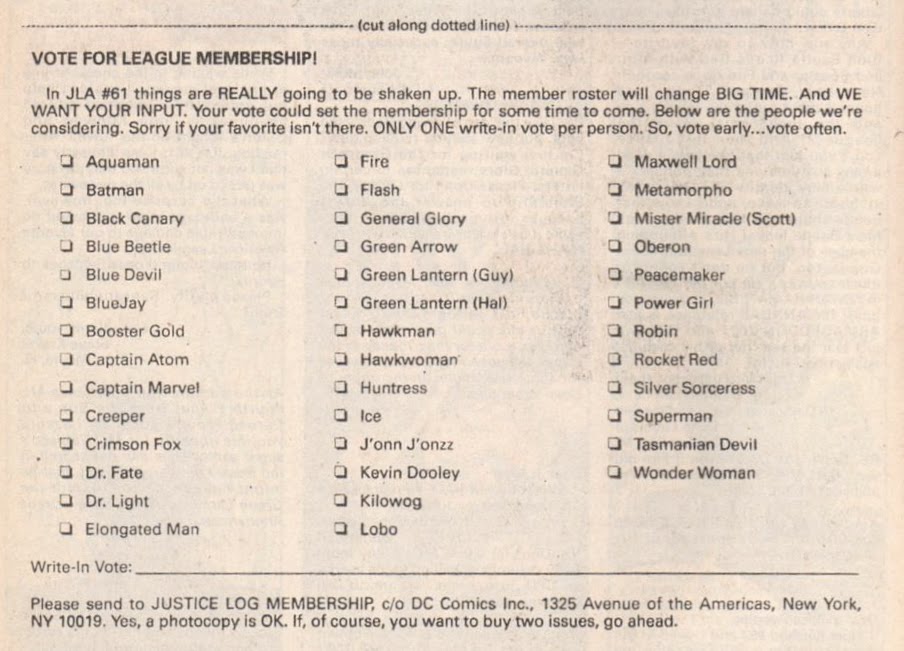
In other League news, L-Ron here officially takes over duties on both books' letters pages, but the execution leaves much to be desired. Most interestingly, "Justice Log" had to be printed following page 6 of the story proper in order to accommodate two painful double-page spreads. (At the opposite end of the interesting scale, L-Ron lets slip that Green Lantern #18 will be a "Breakdowns" crossover. Yeesh.) "Justice Log" and "Europinion" also accidentally run the wrong cover credits--blame it on the robot--so here I'll put things in their proper order. For JLA, it's "Sprouse by Chris pencils, Patterson by Bruce inks, Le Rose by Bob colors ... Oops, circuits got a little crazy there." And for JLE, it's "pencils by Darick Robertson, inks by John Beatty, colors by Bob Le Rose." Finally, in a sign of the awful things awaiting the League following JLA #60, the letters pages include this ballot:


The complete 60 Weeks with the Justice League on The Danger Digest:
#1, #2, #3, #4, #5, #6, #7, #8, #9, #10, #11, #12, #13, #14, #15, #16, #17, #18, #19, #20, #21, #22, #23, #24, #25/1, #26/2, #27/3, #28/4, #29/5, #30/6, #31/7, #32/8, #33/9, #34/10, #35/11, #36/12, #37/13, #38/14, #39/15, #40/16, #41/17, #42/18, #43/19, #44/20, #45/21, #46/22, #47/23, #48/24, #49/25, #50/26, #51/27, #52/28, #53/29, #54/30, #56/32, #57/33, #58/34, #59/35, #60/36


All images this post copyright DC Comics. Original text copyright Jon D. Witmer/The Danger Digest.

Wednesday, August 4, 2010

60 WEEKS WITH THE JUSTICE LEAGUE: Week 49

Justice League America #49
Apr. '91
"Glory Bound, Pt. 4: Glory and Shame"
Guns at the ready, a patriotic song on their lips, those freedom-fighting daredevils of DC strike again!
Keith Giffen, plot & breakdowns
J.M. DeMatteis, script & kibitzing
Linda Medley, pencils
John Beatty, inks
Bob Lappan, letters
Gene D'Angelo, colors
Kevin "Halls of Montezuma" Dooley, asst. editor
Andy "Montezuma's Revenge" Helfer, editor

Justice League Europe #25
Apr. '91
"Nightcrawlers!"
Keith Giffen, creepy plot
Gerard Jones, crawly dialogue
Bart Sears, squirmy pencils
Randy Elliott, wriggly inks
Bob Lappan, slimy letters
Gene D'Angelo, slippery colors
Kevin Dooley, squishy assistance
Andy Helfer, soil aeration


In the penultimate chapter of the "Glory Bound" saga, General Glory's accused of committing war crimes back in the Second World War, namely destroying an Allied P.O.W. camp and killing everyone therein. What with his amnesia and all, the good General can't say for certain that he's innocent, and goes willingly into custody--although Guy Gardner isn't quite so willing to stand by and watch this happen, and it takes the rest of the League to keep him from absconding with Glory and grinding the feds to pulp.


As the story unfolds, Schmidt takes flight in yet another Nazi superweapon, this one a flying sphere called "The Evil Eye." Meanwhile, Joe Mason, the artist of General Glory's old comic book, steps forward to help the League clear Glory's name. It's pretty fantastic (not to mention meta) that the fate of this hero seems to lie in the hands of his illustrator.


Speaking of artists, Medley continues to do excellent work in her fourth consecutive issue, but it's JLE whose pages really shine. The usual team of Sears and Elliott again handle the art chores, but Elliott seems to have upped his game significantly for the final chapter of the Crimson Fox origin arc, truly fleshing out Sears' pencils and adding three-dimensionality to the 2-D page. (Credit, of course, is also due D'Angelo's coloring prowess.) I've liked his inks since he joined this title back in issue 16, but here his contributions clearly elevate the already impressive art.


There being two sisters who share the cowl of the Crimson Fox, and my being pretty in the dark about the character beyond the JLE issues we've so far covered, I did wonder whether one of the two would prove to be expendable in the creators' eyes, but in usual heroic fashion, both D'Aramis sisters survive to continue fighting crime. There's no such happy ending for the giant worms, however, nor for the D'Aramis' sworn nemesis, Puanteur, whose thirst for vengeance completely blinds him to any practical considerations, such as preserving his own neck. This is a morality tale, after all.


"Justice Log" offers some fun facts this issue, great for keeping people entertained at parties, to wit:
The most important question we've ever been asked comes form Michael Thibodoeau, Edmunston, New Brunswick, Canada. It's "What does J'onn prefer most: Oreos, Oreo Double Stuff, or chocolate-coated Oreos?" Answer: yes, but usually the plain ones.
Lots of basic questions from Sigurdur Jonas Gudmundsson, Paris, France, like when we published and who was in our first JLA magazine. The first JUSTICE LEAGUE OF AMERICA was in 1960 and starred Superman, Green Lantern, Batman, and J'onn J'onzz. ... He asks who was DC's first character--probably Oswald the Rabbit in NEW FUN COMICS in 1935.
And of course, what's a letter column without cover credits? From "Justice Log": "Cover Credit Cards: Adam 'Mastercard' Hughes on pencils, Karl 'Visa' Story on inks, and Bob 'AMEX' Le Rose on colors." And from "Europinion": "Cover by Bart, Randy, and Bob--pencils, inks, colors."


The complete 60 Weeks with the Justice League on The Danger Digest:
#1, #2, #3, #4, #5, #6, #7, #8, #9, #10, #11, #12, #13, #14, #15, #16, #17, #18, #19, #20, #21, #22, #23, #24, #25/1, #26/2, #27/3, #28/4, #29/5, #30/6, #31/7, #32/8, #33/9, #34/10, #35/11, #36/12, #37/13, #38/14, #39/15, #40/16, #41/17, #42/18, #43/19, #44/20, #45/21, #46/22, #47/23, #48/24, #50/26, #51/27, #52/28, #53/29, #54/30, #55/31, #56/32, #57/33, #58/34, #59/35, #60/36


All images this post copyright DC Comics. Original text copyright Jon D. Witmer/The Danger Digest.

Wednesday, July 28, 2010

60 WEEKS WITH THE JUSTICE LEAGUE: Week 48

Justice League America #48
Mar. '91
"The Last Giant Nazi Robot Story!"
From the halls of Montezuma to the shores of Tripoli--the saga of General Glory continues, courtesy of our men (and woman!) on the front lines:
Keith Giffen, plot & breakdowns
J.M. DeMatteis, script & kibitzing
Linda Medley, pencils
John Beatty, inks
Bob Lappan, letters
Gene D'Angelo, colors
Kevin D'Ooley, point man
Andrew D'Helfer, commander-in-chief
Special thanks to Paris Cullins & Dave Elliott

Justice League Europe #24
Mar. '91
"Wormfood"
A Keith Giffen, Gerard Jones, Bart Sears, Randy Elliott, Bob Lappan, Gene D'Angelo, Kevin Dooley and Andy Helfer presentation.


The third chapter of the General Glory story continues in fine fashion as the General's arch-nemesis, Herr Schmidt retreats to a Nazi hideaway in South America, whence he guides the giant robot seen on the issue's cover. The creative team continues to fire on all cylinders, and most impressive of all are five pages dedicated to the origin of General Glory (not to mention his erstwhile sidekick, Ernie the Battlin' Boy, who was also apparently the inspiration for Guy Gardner's bowl cut). Presented as though pulled from the pages of the General's self-titled comic book, these pages look fantastic and drive home the homage to Joe Simon and Jack Kirby's Captain America.


JLE's giant-worm/Crimson Fox story, on the other hand, falls into the rut of second-act malaise, treading water in the build-up to next issue's conclusion. In this chapter, the Leaguers chase the worms underground and find their communal resting place, but before anyone can plot a course of action, the maniacal Maurice Puanteur summons the worms to the D'Aramis' Revson facility in London, where one of the Crimson Fox sisters lies trapped, awaiting her apparent demise. I'm still hoping for an exciting third act, but this middle chapter just felt worn out. Anyway, as Royal Tenenbaum would say, "That's just one man's opinion."


Following the stories themselves, JLE's letters offer little beyond the cover credits--"Cover art by Bart Sears & Randy Elliott, color by Bob Le Rose"--while JLA's deliver that and so much more. Cover-credit-wise, we're told "Adam Hughes played the penciller, Karl Story appeared as the inker, and Bob Le Rose was Thorny ... uh ... the colorist." Dooley also writes, "To Mike Lansley, Mechanicsville, MD ... and Liz Hunter (no address on letter) who want to know why Orion changed his costume from that nifty new one to the hideous old one? The new one is his ritual garb for ceremonies and job applications, like JL membership." Better still is this nugget: "Welcome back to terra firma to the crew of the Space Shuttle Columbia. The pilot of the mission was a 42-year-old Air Force Colonel named ... Guy Gardner! Maybe someday we'll show you readers the sketches we did for the flight in cooperation with NASA to be faxed up to the shuttle." I don't suppose anyone knows whether those sketches were ever printed? If so, let me know!


The complete 60 Weeks with the Justice League on The Danger Digest:
#1, #2, #3, #4, #5, #6, #7, #8, #9, #10, #11, #12, #13, #14, #15, #16, #17, #18, #19, #20, #21, #22, #23, #24, #25/1, #26/2, #27/3, #28/4, #29/5, #30/6, #31/7, #32/8, #33/9, #34/10, #35/11, #36/12, #37/13, #38/14, #39/15, #40/16, #41/17, #42/18, #43/19, #44/20, #45/21, #46/22, #47/23, #49/25, #50/26, #51/27, #52/28, #53/29, #54/30, #55/31, #56/32, #57/33, #58/34, #59/35, #60/36


All images this post copyright DC Comics. Original text copyright Jon D. Witmer/The Danger Digest.

Wednesday, June 16, 2010

60 WEEKS WITH THE JUSTICE LEAGUE: Week 42

Justice League American #42
Sep. '90
"Solicitations"
It's the album of the decade brought to you by those lovable mop-tops:
Keith Giffen, acoustic & electric guitars
J.M. DeMatteis, lead vocals
Mike McKone, bass
José Marzan, Jr., piano
Gene D'Angelo, percussion
Bob Lappan, drums
Management: Kevin Dooley
Produced by Andrew Helfer

Justice League Europe #18
Sep. '90
"The Extremist Vector Part Four: The Happy Place"
Keith Giffen, plot/breakdowns
Gerard Jones, script
Bart Sears, pencils
Randy Elliott, inks
Bob Lappan, letters
Gene D'Angelo, colors
Kevin Dooley, wacky
Andy Helfer, wicky


I've been looking forward to this week with both excitement and trepidation since beginning this whole "60 Weeks" experiment. Indeed, for me, JLA #42 is where it all began. Back in 1990, I'd only recently gotten into reading comics, but it didn't take long to hear about the Justice League of America, the premier assemblage of the World's Greatest Heroes. Superman! Batman! The Flash! Other characters whom I was still getting to know! I explained the premise to my folks and how this must surely be the greatest comic book ever put to press, and, if I recall correctly, my dad soon thereafter brought this and issue 43 home for me after stopping by Cleveland's Super City Comics on his lunch break. Admittedly, it wasn't exactly what I'd anticipated--who were these strange characters on the cover? (Hell, I asked myself the same thing before reading it now, in 2010.) At least this Blue Beetle guy looked pretty cool.


Now though, with 20 years having passed and having finally read the previous 40 issues, I must say this issue is fantastic through and through. Hands down one of my favorites of the series. Even McKone's art seems to have taken a quantum leap forward into greatness since just the previous issue, where I was still dogging it; his characters here show tremendous acting chops, and his layouts are all first rate. He still might not be an Adam Hughes or a Kevin Maguire, but he clearly stands on his own and knocks this membership-drive story right outta the park. And speaking of the story, let's finally get to it.

Recognizing the need for more muscle on the team, Max sends Blue Beetle and Fire out to recruit El Diablo, Guy Gardner to recruit Starman, and Ice and Huntress to recruit Hawk and Dove. Each bit, more or less, turns out like this:


Complicating matters further, J'onn feels the need to take some time away to clear his own head after the Despero debacle. His absence should have been mitigated when the real Scott Free returns to Earth after completing his indentured servitude to Manga Khan--it turns out that kooky Mr. Miracle that was blown up and then buried last issue was one of Manga's robot duplicates--but instead he decides to let the world continue thinking he's dead while he takes some time off to barbecue with Barda. All's not completely hopeless, though: First, Max trades the test-tube remnants of Despero to Manga Khan for Manga's erstwhile robo-servant L-Ron; then, on the last page, New Gods Orion and Lightray arrive at the embassy, ready for action.


JLE's also a fine piece of work this time out, and definitely the most entertaining chapter yet of "The Extremist Vector" storyline. Trapped in Silver Sorceress' nuked-out dimension, the Leaguers are summoned to Wacky World, a pristine amusement park populated by lifelike robots who, in turn, demonstrate a religious devotion to the park's "visionary" (apparently a sort of cross between Walt Disney and L. Ron Hubbard) and his living servant/prophet/freakazoid, Carny. Carny, in turn, has been holding Silver Sorceress captive, and now he's bent on keeping the JLE imprisoned in his house of horrors. Zaniness ensues, and when said zaniness goes against Carny's plans, the big boy throws a fit and blows up Wacky World. The League, protected by Metamorpho, appears to be safe; the Sorceress' fate is less clear; and the last page reveals a mysterious figure waking from some techno-slumber contraption. Perhaps it's the visionary himself?


"Justice Log" alerts us to these cover credits for JLA: "Adam Hughes, pencils/inks; Bob Le Rose, colors." No letters page this month in JLE--instead, there's an ad for Justice League Quarterly, which I won't be covering during this initial 60 Weeks project, but I do hope to come back around for sometime next year--but how about that cover, referencing JLI #11?


The complete 60 Weeks with the Justice League on The Danger Digest:
#1, #2, #3, #4, #5, #6, #7, #8, #9, #10, #11, #12, #13, #14, #15, #16, #17, #18, #19, #20, #21, #22, #23, #24, #25/1, #26/2, #27/3, #28/4, #29/5, #30/6, #31/7, #32/8, #33/9, #34/10, #35/11, #36/12, #37/13, #38/14, #39/15, #40/16, #41/17, #43/19, #44/20, #45/21, #46/22, #47/23, #48/24, #49/25, #50/26, #51/27, #52/28, #53/29, #54/30, #55/31, #56/32, #57/33, #58/34, #59/35, #60/36


All images this post copyright DC Comics. Original text copyright Jon D. Witmer/The Danger Digest.

Wednesday, June 2, 2010

60 WEEKS WITH THE JUSTICE LEAGUE: Week 40

Justice League America #40
Jul. '90
"Hell on Earth"
Keith Giffen, J.M. DeMatteis, Adam Hughes, José Marzan Jr., Bob Lappan, Gene D'Angelo, Kevin Dooley, and Andy Helfer present perhaps the strangest Justice League tale ever! (And considering how weird this book usually is, that's saying a lot!)

Justice League Europe #16
"The Extremist Vector Part Two: Conquest"
Keith Giffen, plot & breakdowns
Gerard Jones, dialogue
Bart Sears, pencils
Randy Elliott, inks
Bob Lappan, letters
Gene D'Angelo, colors
Kevin Dooley, sound
Andy Helfer, fury


First, a confession: I was remiss in my duties last week and failed to mention the debut, in JLE, of Power Girl's new threads. Of course, looking at the outfit, perhaps you'll wish I'd continued to spare you from acknowledging this embarrassing historical footnote.


So long as we're taking people--myself included--to task for clerical errors, let's also note that JLE's cover credits mistakenly name DeMatteis in place of Jones. Inside the book, I failed to recognize that Randy Elliott took over inking from Pablo Marcos this issue, but I suppose that just goes to show you that editorial did a bang-up job finding a replacement for Marcos. The story itself finds the JLE boarding a borrowed JLA cruiser to fly to Moscow, lest the Extremists slaughter them as they materialize in the transporters. By the time the League arrives, however, Moscow--and her protectors, the Rocket Red brigade--have been laid to ruin, and it doesn't take long for the Leaguers themselves to be incapacitated, leaving the Extremists to go destroy the next city they encounter. This is gonna be an ugly, protracted battle, I suspect.


Most bizarre in this issue of JLE is a completely unnecessary retcon of the Blue Jay/Silver Sorceress/Wandjina backstory. I understand that the creative team is trying to work in the Extremists, but saying Blue Jay and co. jumped back and forth between worlds a couple of times, and then showing them trading punches with Hal Jordan, is completely uncalled for. We know how this stuff played out back in Justice League #2, and boy howdy, this ain't the way it was:


Over in America, I'm not entirely sure the book lives up to its title-page promise of being stranger than ever--Kooey Kooey Kooey is still fresh in my mind--but it is a pretty fascinating read, ably complemented by guest inker José Marzan Jr., who does a fine job filling in for Rubinstein, although I hope the latter returns soon, all the same. Divided evenly into two acts, the book's first half finishes the Despero storyline, with J'onn infiltrating Despero's mind and offering the alien villain "mayavana," a once-in-a-lifetime Martian offering that creates a perceived reality in the receiver's consciousness that's even more convincing than the actual reality in front of his eyes; with this gift, J'onn convinces Despero that he's succeeded in defeating the Justice League and destroying the Earth in toto. The whole experience reduces Despero to a fetus-like state of suspension (from which he'll no doubt be resurrected again down the line).


Complete with costumed heroes attending a funeral and bold black borders lining every page and panel, act two is all about mourning for Scott Free, a.k.a. Mr. Miracle, whom Despero blew up last issue. Forgive me if I sound callous here, but JLA and JLE's letters pages run solicitations for Mr. Miracle's book, so I feel confident he's not actually dead. However, my confidence isn't shared by the cast of characters. Barda blames Max and lets him know with a powerful haymaker. Superman tells Batman (who in turn tells Max) that the League hasn't got enough muscle, and unless it gets more, Scott will be the first of many casualties. After thoughtlessly trying to recruit Gypsy for his new team at the cemetery, Booster gets scolded by Beetle and returns to his new Conglomerate office, where he's in no mood for Claire Montgomery's news that Praxis has sent "a confirmation." And then, there's Guy and Ice:


It's time once again for cover credits! From "Justice Log":"Adam Hughes did pencils 'n' inks, Bob Le Rose did colors 'n' stuff." From "Europinion": "Bart Sears on pencils, Joe Rubinstein on inks, Bob Le Rose on colors, Andy Helfer on lead guitar."

Meanwhile, the Dick Tracy marketing train keeps chugging along:


The complete 60 Weeks with the Justice League on The Danger Digest:
#1, #2, #3, #4, #5, #6, #7, #8, #9, #10, #11, #12, #13, #14, #15, #16, #17, #18, #19, #20, #21, #22, #23, #24, #25/1, #26/2, #27/3, #28/4, #29/5, #30/6, #31/7, #32/8, #33/9, #34/10, #35/11, #36/12, #37/13, #38/14, #39/15, #41/17, #42/18, #43/19, #44/20, #45/21, #46/22, #47/23, #48/24, #49/25, #50/26, #51/27, #52/28, #53/29, #54/30, #55/31, #56/32, #57/33, #58/34, #59/35, #60/36


Dick Tracy ad copyright Disney. All other images this post copyright DC Comics. Original text copyright Jon D. Witmer/The Danger Digest.

Wednesday, September 16, 2009

60 WEEKS WITH THE JUSTICE LEAGUE: Week 3


Justice League #3
July ‘87
“Meltdown”
Keith Giffen: plot & breakdowns
J.M. DeMatteis: script
Kevin Maguire: pencils
Al Gordon: inks
Bob Lappan: letters
Gene D’Angelo: colors
Andy Helfer: editor
Special thanks to Terry Austin


As did issue 2, issue 3 ends with another would-be letters page commandeered by editor Andrew Helfer. I give him credit for emphasizing the important role of the inker, letterer and colorist, but when he writes “Gene is one of the few guys that can take characters of fifty different colors and find a background color that NONE of theme fade away against,” it really seems to diminish the thoughtfulness and artistry that goes into good coloring and, indeed, is evident in D’Angelo’s work. Perhaps more illuminating is Helfer’s quick run-through of the creative process behind this book:

“Mr. Giffen plots the story first--that is, he sits down with the editor at regular intervals (usually once a month) and figures out the events that will take place in any given issue. This includes both major plots, subplots, character ‘bits’ and anything else the plotter cares to toss in. Usually, the average writer will then hand in a typed, page-by-page breakdown of the story, which the penciller will then illustrate; in Mr. Giffen’s case, an uncontrollable fear of typewriters (or maybe just their ribbons) forces him to produce his plots as a set of mini-pages, which acts as a layout ‘guide’ for the pencil artist [….] Once the page is penciled, the entire package is shipped off to the scripter, who dialogues the pages based on the plot.”


Helfer goes on to explain scripter J.M. DeMatteis’ late arrival to the title; apparently the plotted and penciled pages for the first issue sat for some time before DeMatteis was officially on the book and writing the dialogue, which in turn slowed the inking process, requiring Al Gordon to take over responsibilities from Terry Austin. To my mind, even though this essentially describes the now-antiquated “Marvel Method,” when two writers are involved, it opens the door for a disconnect between the art and text such as is seen on page 12:


If the man in the red suit is the first to recognize the danger, his expression in the fourth panel seems redundant at best and awkward or downright inconsistent at worst. My suspicion (and it is only a suspicion) is that DeMatteis’ script changed the action Maguire penciled from Giffen’s breakdowns; it looks suspiciously like the workers seen in the first two panels realize the danger when the screen illuminates in panel three, and the man in the foreground of panel four is the only one who voices the reality these players are all suddenly made aware of.

But I’m getting ahead of myself. Sticking with the art for a moment but jumping back to the book’s cover, I feel this issue is a definite improvement over issue 2, but it still falls short of the bold standard set by the series’ first issue. All the same, I very much respect the composition, with the title itself pointing to our heroes, who are further caged by the fence (made to look even more threatening thanks to the illustration’s perspective) and the encircling Rocket Red Brigade.

The 22-page story itself plays out pretty straightforwardly: Colonel Harjavti convinces Wandjina, Silver Sorceress and Bluejay--the three aliens who have come to Earth to destroy the planet’s nuclear arsenal and prevent the type of global cataclysm that left their home world a lifeless husk--to remove the Soviet Union’s warheads, leaving the Justice League no choice but to breach Soviet airspace and risk an international “incident” to stop the trio.


Inside Russia, the team is stopped by the Soviets’ super-guardians, the Rocket Red Brigade, and airborne fisticuffs naturally ensue. However, with so many super-powered folk flying around uninvited, Russia’s nuclear infrastructure goes on high alert, and when the nuclear power plant from page 12 improperly shuts down, the Rocket Reds are forced to seek the League’s assistance in preventing a core meltdown.


Arriving at the plant, the general consensus is it’s too late to do anything, until Wandjina flies into the belly of the beast, apparently sacrificing himself to save the day--an act of heroism the rest of this cast seems incapable of performing. (Granted, I can appreciate that it’s bad for business to kill Batman--oh, wait. Anyhow, back in ’87, it wasn’t so easy for DC’s characters to return from the dead.)


Kicked out of the Soviet Union as soon as the crisis has been averted, the JL returns to headquarters, where they find the enigmatic Maxwell Lord waiting with the League’s “newest member,” Booster Gold.


Lord also factors into the middle of this book, when he makes a phone call to Gorbachev himself (or at least his cartoon counterpart) in order to smooth over the JL’s intrusion into the U.S.S.R.


Over this series’ first three issues, I dare say Lord’s behind-the-scenes moves have been the most interesting--or intriguing, anyway--story beats, and I’m hopeful that his stepping out of the shadows will pay dividends over the next few (or, ideally, more) issues.

It’s certainly noteworthy that thus far, the League has spent most of its time either fighting amongst itself or chasing after three aliens whose mission was essentially righteous. It’s a sign of the times that the Cold War takes such a front seat, and it’s significant that Reagan is frequently name-dropped and Gorbachev actually makes an appearance. This iteration of Justice League began its run roughly a month after Reagan addressed the nation regarding the Iran-Contra affair, and only a year and a half after the Challenger tragedy. It’s disingenuous, of course, to say that in 1987 the world seemed decidedly real, but for whatever reason, the “real world” was invited into the pages of our four-color entertainment. (In truth, this could well have to do with the aftermath of DC’s epic Crisis on Infinite Earths: After decades of multiple Earths existing across the dimensional planes, the company wanted its readers to know that the One World that remains is very much Our World.)

More next week…


The complete 60 Weeks with the Justice League on The Danger Digest:
#1, #2, #4, #5, #6, #7, #8, #9, #10, #11, #12, #13, #14, #15, #16, #17, #18, #19, #20, #21, #22, #23, #24, #25/1, #26/2, #27/3, #28/4, #29/5, #30/6, #31/7, #32/8, #33/9, #34/10, #35/11, #36/12, #37/13, #38/14, #39/15, #40/16, #41/17, #42/18, #43/19, #44/20, #45/21, #46/22, #47/23, #48/24, #49/25, #50/26, #51/27, #52/28, #53/29, #54/30, #55/31, #56/32, #57/33, #58/34, #59/35, #60/36


All images this post plus Andrew Helfer quotes copyright DC Comics. Original text copyright Jon D. Witmer/The Danger Digest.